
CI#
An overview of the environments and the virtual, and physical resources utilized for the xNVMe CI is illustrated below.
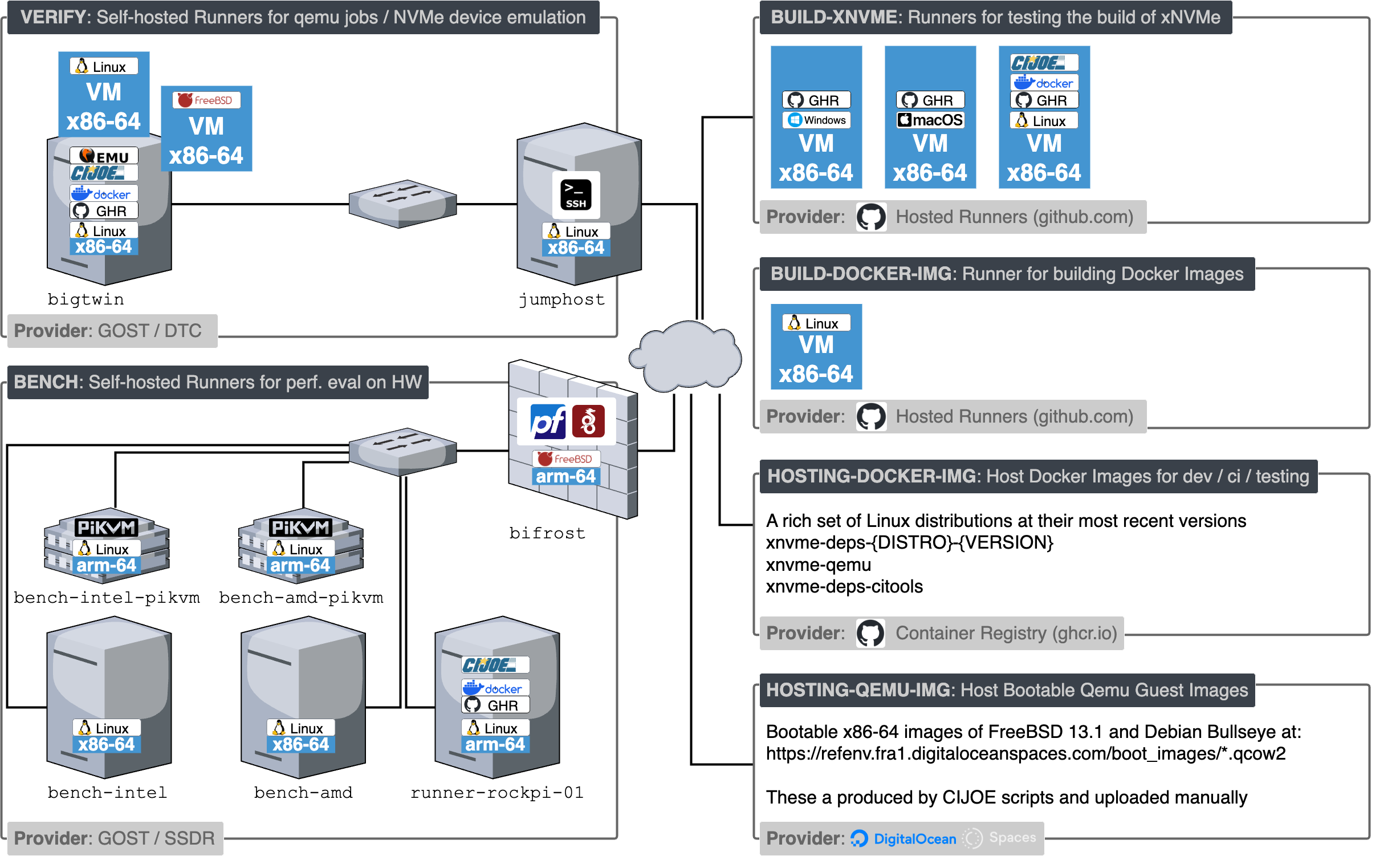
xNVMe CI environments and resources#
The above figure is outdated, as bench and verify have been migrated to a MaaS provider and are no longer on-premises. However, one system remains on-prem because no MaaS provider currently offers a suitable replacement.
Infrastructure#
The main logical infrastructure component for the xNVMe CI is GitHub Actions (GHA). GHA handles events occuring on the following repositories:
And decides what to execute and where. In other words GHA is utilized as a resource-scheduler and pipeline-engine. The executor role is delegated to CIJOE for details, then have a look at CIJOE in xNVMe.
The motivation for this separation is to make it simpler to reproduce build, test, and verfication issues occuring during a CI run, using locally available resources, by executing the CIJOE in xNVMe workflows and scripts.
Jobs#
The jobs performed by the xNVMe CI catch the following issues during integration of changes / contributions:
Code format issues
Linting and code-formating
clang-format for C
clippy for Rust
black / ruff for Python
Build issues
Build with debug enabled and disabled
Detect linking issues with both the static and shared library
Tested on every OS listed in the Toolchain section
Functional regressions
Running logical tests exercising all code-paths
Using a naive “ramdisk” backend
Using emulated NVMe devices via qemu
Using physical machines
In addition to cathing issues, then the CI is also utilized for:
Benchmarking of xNVMe
Using physical machines
Measure peak IOPS for a single physical CPU core
Specifically for the integration of xNVMe in SPDK (
bdev_xnvme)
Statically Analyze the C code-base
CodeQL via GitHub
Coverity
Produce and deploy documentation
Run all example commands (
.cmdfiles) and collect their output in.outfilesRender the Sphinx-doc documentation as HTML
Upload rendered documentation to xnvme.io via GitHub-pages
These following sections provide system-setup notes and other details for the various CI jobs.
Containers and guest images#
Two of the CI jobs run inside a Docker host container (set by GHA’s
container: directive), and several boot a QEMU guest as part of their
work. Both come from nosi, which publishes base images as OCI artifacts
on GHCR.
Host containers carry the toolchain the GHA job itself uses: QEMU binaries, CIJOE, devbind / hugepages helpers.
Guest disk images are the qcow2 boot disk the in-job QEMU instance runs. They are pulled in-job by the
stage_nosi_guestCIJOE script (invoked fromprovision-using-tgz.yamlandprovision-maas-using-tgz .yamlright beforeguest_initialize), which talks directly to the OCI Distribution API via stdliburllib(noorasCLI dependency); the blob digest is pinned in each CIJOE config’s[guest_image].url. The nosi guests ship with root locked and an operator accountodus;cijoe/scripts/root_unlock.pyruns right afterguest_startto open root SSH so the rest of the CIJOE workflow continues as root unchanged (Linux useschpasswd+systemctl, FreeBSD usespw usermod+service sshd reload).
Job |
Host container |
Guest disk image |
|---|---|---|
|
|
|
|
|
|
|
|
|
|
n/a (self-hosted MAAS runner) |
|
|
n/a (self-hosted MAAS runner) |
|
|
n/a (self-hosted MAAS runner) |
|
|
n/a (self-hosted MAAS runner) |
|
|
|
|
All container-hosted jobs now run on the nosi ubuntu-2604-docker image
with upstream QEMU; the NVMe KV command set is supplied by
vfio-user-kvssd over vfio-user. The MAAS jobs run directly on
bare-metal hardware so do not need a host container.