
NVMe Transports#
The NVMe specification defines several transports for issuing commands to a controller. PCIe is the local memory-mapped transport used by directly attached SSDs. TCP and RDMA (iWARP, InfiniBand, RoCE) are network-message transports for accessing a remote controller over the network.
A note on vocabulary. Material you may have read elsewhere refers to the network-message transports collectively as NVMe-over-Fabrics (NVMe-oF). The NVMe 2.0 refactor folded the previously separate base and fabrics specifications into a single document and unified the vocabulary: PCIe, TCP, and RDMA are all just transports now. This page uses the post-2.0 terminology; older guides and tools may still say “fabrics” for the same network paths.
The terms initiator and target are not defined by the NVMe specification at all. They are inherited from SCSI, where they have precise meaning, and have become the common informal vocabulary used to label the two roles involved in an NVMe network transport such as TCP or RDMA: the initiator is the side issuing commands, the target is the side processing them. This page uses them in that informal sense.
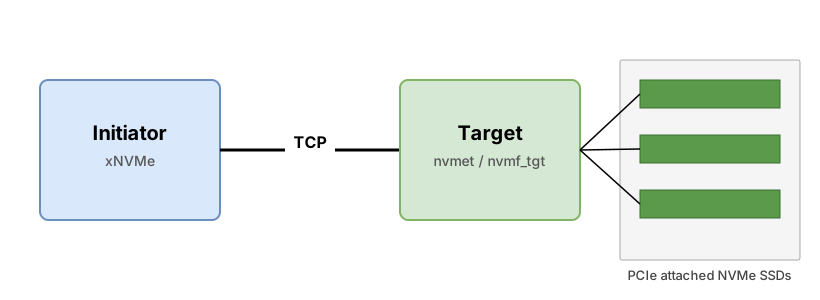
Roles in an NVMe TCP transport setup#
xNVMe currently implements only the initiator side of the NVMe protocol; it does not provide an NVMe target. To exercise the TCP transport the target role is delegated to one of two external implementations, documented on their own pages. A native target along with device emulation is on the roadmap, with no committed timeline.
SPDK Target uses the user-space nvmf_tgt
application. The PCIe device is bound to the userspace driver via
xnvme-driver, attached to nvmf_tgt as Nvme0, and published as a TCP
subsystem through rpc.py.
Linux Target uses the in-tree nvmet driver
configured through configfs. The PCIe device is rebound to the kernel
NVMe driver so its local /dev/nvmeXn1 can be exported as a nvmet
namespace.
Both providers are driven by the same nvme_target_start,
nvme_target_probe, and nvme_target_stop cijoe scripts; start and stop
are switched via --nvme-provider, probe discovers whichever is listening.
The initiator side (xNVMe access via a fabrics URI) is identical between the
two and is documented below.
Script configuration#
nvme_target_start.py, nvme_target_probe.py, and nvme_target_stop.py
each take their own set of arguments; --transport-name is the one all three
share.
nvme_target_start.py accepts the following arguments:
Argument |
Default |
Description |
|---|---|---|
|
|
|
|
|
Transport type. |
|
|
Address family. |
|
None |
CIJOE Transport to use. Defaults to first-found, if not specified. |
nvme_target_probe.py accepts the following arguments:
Argument |
Default |
Description |
|---|---|---|
|
|
Transport type. |
|
None |
CIJOE Transport to use. Defaults to first-found, if not specified. |
nvme_target_stop.py accepts the following arguments:
Argument |
Default |
Description |
|---|---|---|
|
|
|
|
None |
CIJOE Transport to use. Defaults to first-found, if not specified. |
The devices to export are the entries labelled fabrics (legacy label
name) in the cijoe configuration. Each entry becomes one subsystem. An entry
has these fields:
Field |
Description |
|---|---|
|
Address and port to listen on, e.g. |
|
PCIe address of the device, e.g. |
|
NQN of the subsystem. |
|
|
|
Block device, e.g. |
Give every entry its own port, so the initiator can find each subsystem
without a --subnqn. A namespace without a block device, such as KV, needs
passthrough. The Linux provider does not support passthrough and skips such
entries.
nvme_target_probe.py probes the first entry.
Initiator usage#
The probe step in each provider’s demo workflow exercises the initiator side against the brought-up listener. The xNVMe commands it issues are extracted from the live cijoe run and shown below:
xnvme enum --uri 127.0.0.1:4420
xnvme info 127.0.0.1:4420 --subnqn nqn.2019-08.org.qemu:beef0003
xnvmeperf run 127.0.0.1:4420 --subnqn nqn.2019-08.org.qemu:beef0003 --iopattern randread --iosize 4096 --qdepth 32 --nqueues 1 --runtime 5 --cpumask 0x4
The captured output for each command, along with the surrounding
nvme discover invocation, is visible in the embedded report on the
SPDK Target or Linux Target page.
Footguns and rules of thumb#
The local loop-back scenario (initiator and target on the same machine
over 127.0.0.1) is a useful sanity check but is bounded by CPU and
memory rather than the device, and its numbers should not be read as
representative of the TCP transport. The SPDK target pins nvmf_tgt to
core 1 via -m [1] and busy-polls that core at 100% even when idle, so
any initiator thread that also lands on core 1 starves immediately; pin
the initiator elsewhere with --cpumask 0x4 (or any mask whose set bits
exclude bit 1). With the cores
split, the two processes still share L3 cache and memory channels, so at
small block sizes a single core can saturate the loop-back I/O path
while the device itself is barely touched, and at large block sizes
memory bandwidth becomes the next ceiling. The kernel’s TCP/IP stack
also runs in full in the data path with its usual per-byte CPU cost, so
what looks like a fabric benchmark is, in this configuration, largely a
CPU benchmark.
Across separate machines the visible limit shifts to the link itself.
Use the fastest interface available; on direct back-to-back links raise
the MTU as high as the cards support
(ip link set dev ${NETWORK_INTERFACE} mtu ${DESIRED_MTU}). If the
device cannot be saturated through the available network, hide more
latency by using a larger block size and/or higher io-depth.